


Executive Summary: Chunky and platform sneakers remain a top-selling silhouette in women's fashion and streetwear footwear, yet brands frequently suffer from an average 25% to 32% e-commerce return rate. The root causes are mechanical: excessive bottom unit weight (>450g), rigid platform leverage causing severe heel slippage, rapid midsole compression creasing, and lateral ankle instability. This comprehensive engineering guide details how specialized OEM/ODM manufacturing resolves these defects through supercritical nitrogen-infused EVA, dynamic rocker sole geometry, anatomical heel-lock cradles, and dual-density co-molding.
1. The 4 Engineering Flaws That Ruin Women's Chunky Sneakers
Modern chunky sneakers feature sole stack heights between 40mm and 65mm. While visually bold and commercial, increasing sole thickness fundamentally alters the biomechanics of natural walking gait. When mass-market factories build platform sneakers using standard casual shoe construction, four predictable mechanical failures occur across consumer wear cycles:
- Excessive Unit Weight (>450g per shoe): Solid rubber outsoles and standard high-density compression-molded EVA create bottom-heavy footwear. Wearers expend excessive muscular effort from the tibialis anterior during swing phase, leading to premature leg fatigue, shin splints, and poor product satisfaction.
- Platform Lever Effect and Heel Slip: A thick platform sole cannot flex 40° to 45° at the metatarsophalangeal break during toe-off. Because the sole remains rigid, the stiff bottom acts as a physical lever arm, pulling the wearer's heel straight downward and out of the rearfoot collar with every stride.
- Premature Midsole Creasing and Sag: Low-density casual EVA midsoles suffer from poor compression set resistance. Within 10 to 14 days of daily wear, the foam collapses under cyclic body weight, creating unsightly diagonal wrinkles and permanent medial tilt.
- Lateral Rolling and Ankle Instability: Elevated stack heights significantly raise the wearer's center of gravity. Without calculated base widening and ground-contact flaring, wearers face high rotational torque and severe ankle inversion risks on uneven street pavement.
2. Technical Solution 1: Reducing Sole Weight to Under 260g
The foundation of a wearable chunky sneaker is replacing dense compound slabs with advanced microcellular foam technologies that preserve exaggerated visual volume while shedding dead mass.
| Midsole Technology | Density (g/cm³) | Weight (EU 38 Pair) | Energy Rebound | Crease Resistance |
|---|---|---|---|---|
| Standard Die-Cut EVA | 0.28 – 0.32 | 480g | 42% | Poor (Fails at 50k steps) |
| Injection Phylon (IP) | 0.20 – 0.24 | 350g | 54% | Moderate |
| Supercritical Nitrogen EVA | 0.14 – 0.16 | 240g | 68% | Excellent (>150k steps) |
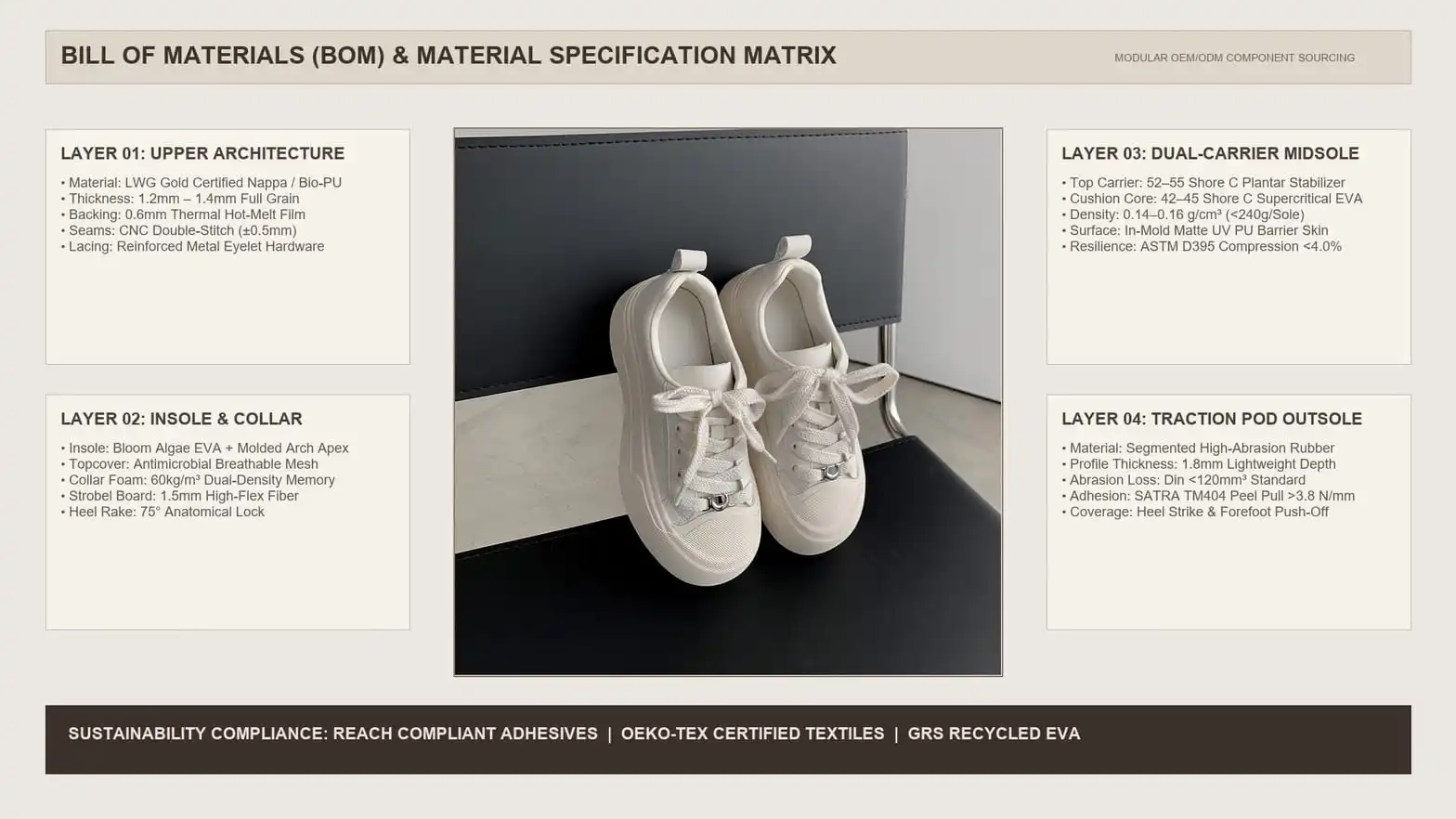
Engineering Best Practices for Weight Optimization:
- Hollow Core Internal Cavities: Utilizing precision CNC aluminum molds to core out non-load-bearing internal volumes of the midsole, shaving 35g to 50g per shoe while preserving structural sidewall wall thickness (≥3.5mm) to maintain compression strength.
- Targeted Rubber Pod Outsoles: Eliminating full-length 4mm heavy rubber outsole sheets in favor of segmented 1.8mm high-abrasion rubber pods (Din <120mm³) placed strictly at the high-wear heel strike zone and forefoot push-off trajectory.
3. Technical Solution 2: Eliminating Heel Slippage via Rocker Sole Geometry
Because a 50mm platform sole cannot flex like a traditional 15mm cupsole, the shoe must roll forward biomechanically through geometric bottom curvature rather than forced material bending.
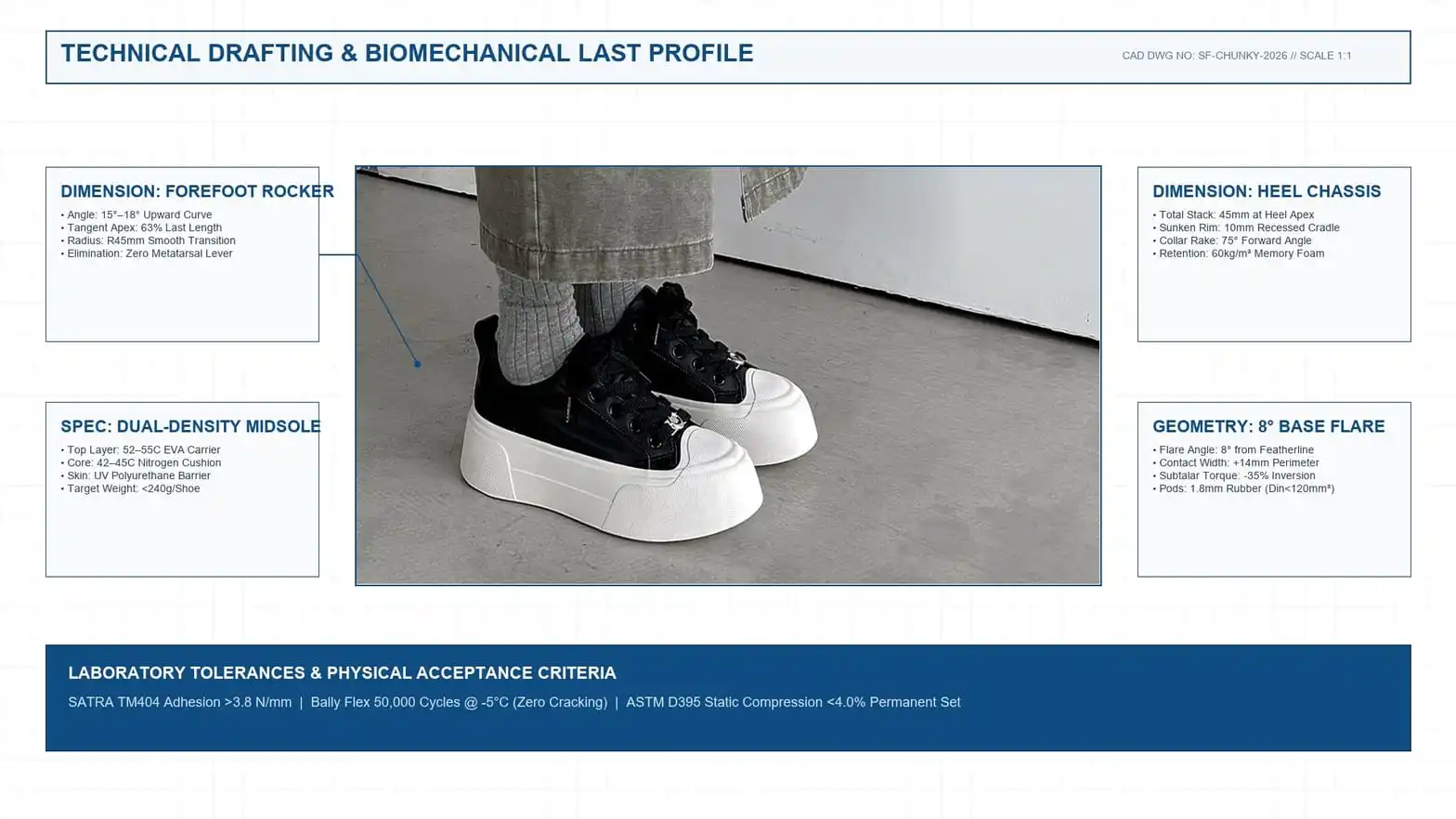
*Forefoot Rocker Angle (15° to 18°)
By positioning the rocker apex pivot point at 62% to 65% of the total last length (aligning directly beneath the first metatarsal head) and beveling the bottom profile upward toward the toe tip at a 15° to 18° rocker angle, the shoe glides through toe-off smoothly. This eliminates the bending resistance that would otherwise lever the heel downward and out of the collar.
*Sunk Footbed Cradle Architecture (Drop-In Seat)
Rather than resting the lasted upper flat on top of the midsole, the insole board and upper are seated 8mm to 12mm deep inside a sunken perimeter sidewall rim. This lowered anatomical center of gravity firmly locks the calcaneus bone inside the structural chassis and prevents lateral foot shift.
*Asymmetric 3D Achilles Pillow Collar
The rearfoot collar is engineered with a forward-leaning 75° Achilles rake angle, reinforced with multi-density molded memory foam pads (60 kg/m³) that cup the superior border of the calcaneus, preventing micro-slippage and blister-causing friction during active walking.
4. Technical Solution 3: Preventing Midsole Creasing and Lateral Roll
To maintain aesthetic luxury and physical structural integrity over months of continuous customer wear, the midsole compound and platform footprint must be engineered with specific dual-density co-molding and geometric flare strategies.
-
Dual-Density Dual-Carrier Molding
Standard single-density EVA fails because soft foam compresses permanently, while hard foam ruins underfoot comfort. Agile manufacturers resolve this through a co-molded dual-carrier architecture:
- Top Carrier Layer (Underfoot): Molded at a firmer 52–55 Shore C durometer to distribute plantar pressure evenly across the foot and prevent localized heel sinking.
- Bottom Cushioning Core: Molded at a resilient 42–45 Shore C durometer using supercritical nitrogen foam to deliver high energy return and impact absorption.
-
8° Outward Base Flare for Stability
Elevated platform soles raise the wearer's center of mass, multiplying lateral torque during uneven foot strike. By angling the midsole sidewalls outward at an 8° flare angle relative to the upper boundary, the ground-contact base is expanded by 12mm to 16mm. This broad perimeter foundation eliminates ankle wobble and inversion injuries without altering the sleek aesthetic proportions of the upper.
-
High-Flex UV Polyurethane Protective Skin
Applying an in-mold matte polyurethane barrier coating over the EVA perimeter seals open foam micro-cells against environmental air oxidation, moisture ingress, and ultraviolet degradation, ensuring the sidewalls remain wrinkle-free across extended retail shelf life and consumer use.
5. Critical Technical Specifications for Chunky Sneaker Tooling
Achieving the perfect balance between dramatic visual fashion and comfortable walking biomechanics requires precise compounding and tooling parameters:
| Engineering Parameter | Production Tolerance / Specification | Target Technical Benefit |
|---|---|---|
| Midsole Core Density | Supercritical Nitrogen EVA (0.14 – 0.16 g/cm³) | Reduces total bottom weight under 240g per shoe |
| Top Carrier Hardness | 52 – 55 Shore C Durometer | Distributes plantar load and prevents medial collapse |
| Forefoot Rocker Apex | 15° – 18° angle positioned at 62%–65% last length | Eliminates toe-off resistance and collar heel levering |
| Sunken Heel Seat Depth | 8mm – 12mm recessed sidewall perimeter rim | Locks calcaneus inside shoe chassis to prevent slippage |
| Midsole Base Flare Angle | 8° outward flare relative to featherline | Expands ground contact base and prevents ankle inversion |
| Adhesion Peel Strength | SATRA TM404 verified (>3.8 N/mm pull force) | Guarantees permanent bond without delamination |
| Compression Set (ASTM D395) | < 4.0% thickness reduction under 24h 50kg load | Ensures zero diagonal wrinkling across daily wear cycles |
6. Quality Testing Protocols and Batch Acceptance Thresholds
To ensure consistent defect-free delivery across production runs, women's chunky sneakers must undergo specialized physical laboratory stress testing prior to container dispatch:
- *Whole-Sole Bally Flex Fatigue Testing: Platform midsoles undergo continuous flex testing on calibrated Bally flexometers for 50,000 cycles at room temperature and -5°C. Samples must demonstrate zero cracking, surface crazing, or delamination across the thickest cross-section of the sole.
- *Upper-to-Midsole Adhesion Peel Resistance: Cement line integrity is verified using digital tensile pull testing according to SATRA TM404 standards. Minimum peel strength must exceed 3.8 N/mm along the critical toe-spring and heel-seat perimeters to prevent field sole separation.
- *Static and Dynamic Compression Set: Under 24-hour continuous 50kg static load testing at 40°C, permanent midsole thickness reduction must remain below 4.0%, ensuring long-term cushioning resilience and preventing uneven heel collapse.
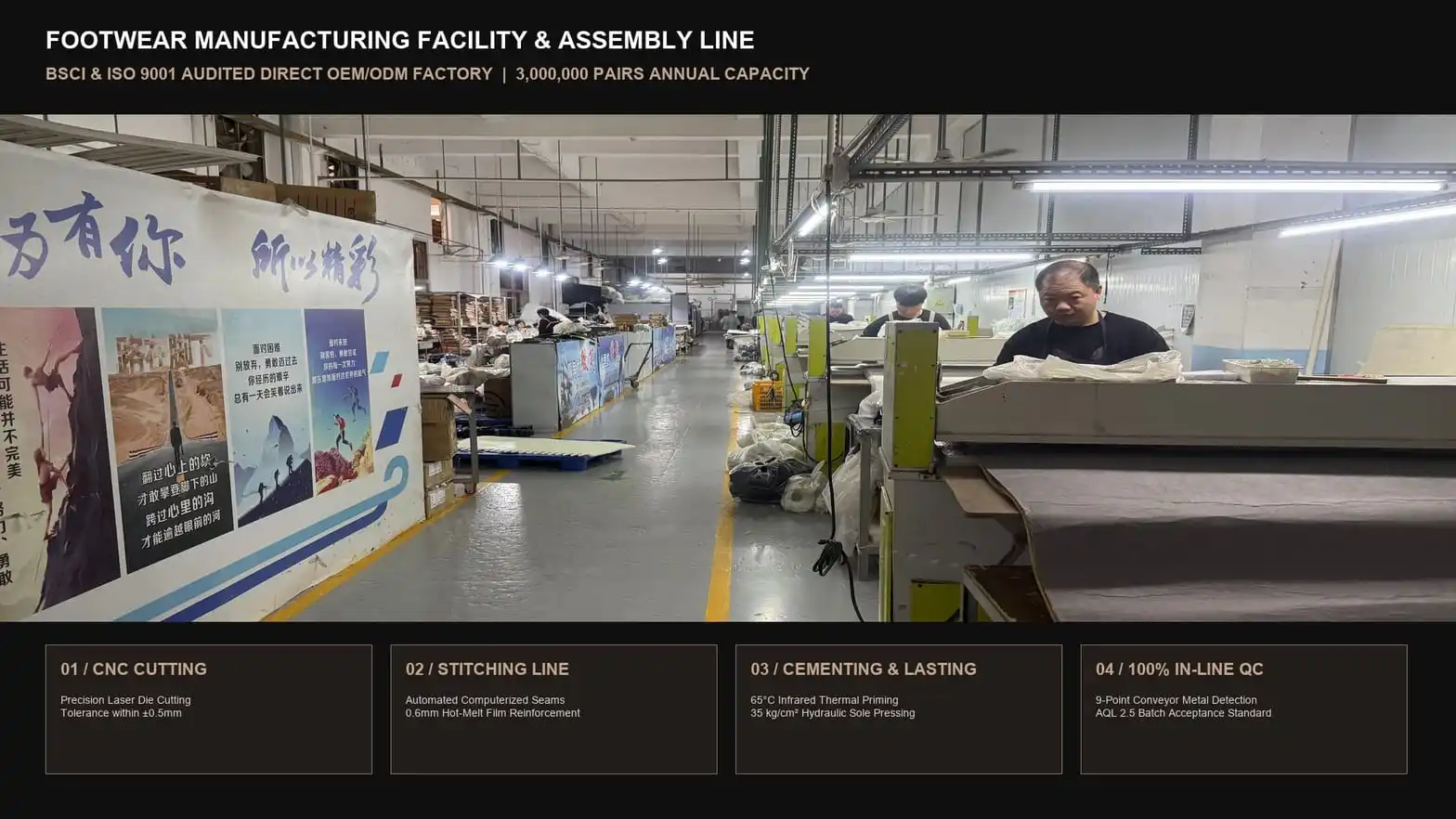
- *100% Conveyor Metal Detection: Prior to final master carton packing, all finished footwear pairs pass through calibrated 9-point conveyor metal detectors to ensure complete absence of broken needle tips or foreign metallic debris.
7. Frequently Asked Questions (FAQ)
-
What is the recommended stack height for commercial women's chunky sneakers?
For balanced fashion aesthetics and daily walking comfort, the optimal heel stack height is 42mm to 48mm, with a forefoot stack of 28mm to 32mm, maintaining a natural heel-to-toe drop of 12mm to 16mm.
-
Can small brands develop custom chunky soles without expensive mold tooling?
Yes. Agile OEM/ODM manufacturers maintain open-mold tooling libraries for modern chunky sole profiles. Brands can customize the upper pattern, material layering, logo plates, and colorblocking with zero initial tooling investment and flexible 300-500 pairs per colorway MOQs.
-
How do you prevent large-size chunky sneakers (US 9–11) from looking disproportionate?
By implementing non-linear tooling grading. Rather than scaling all dimensions proportionally, the waist width and sidewall height are capped at size US 8.5, extending only the toe length and heel bevel to maintain a sleek, flattering profile across larger sizes.
-
What is the typical production timeline for custom chunky sneaker manufacturing?
Utilizing existing open-mold libraries, initial prototypes are completed in 15 to 20 business days. Bulk production for orders between 300 and 3,000 pairs typically requires 45 to 60 business days following pre-production (PP) sample approval.
-
How do you prevent EVA platform soles from smelling or deteriorating?
By using high-grade virgin EVA copolymer pellets blended with odorless cross-linking agents and water-based bonding primers compliant with international REACH and CPSIA environmental standards.
-
Can the factory accommodate custom branded rubber logo plates on existing chunky sole molds?
Yes. Existing open molds feature modular interchangeable heel badges and shank inserts. Brands can embed proprietary molded TPU/rubber logos, dual-color spray fades, or custom laser engraving with minimal setup cost ($150–$300) without opening new master sole molds.
Ready to Develop High-Performance Women's Platform Sneakers?
Work with an experienced OEM/ODM manufacturer specializing in lightweight sole formulations, female biomechanical lasts, and flexible 300-pair production runs.
REQUEST SAMPLE DEVELOPMENT & CATALOG


