


Wide Width Women's Sneakers: The Fit Problem Brand Buyers Keep Paying For
A buyer of ours placed 1,200 pairs, sold 936, and took back 28% - about $4,717 lost. I do not read that as a quality failure. Fit is settled before production, in a last nobody specified and a grading table nobody questioned. That is why I treat wide width women's sneakers as an engineering brief, not a product tag.
1. Fit is not a comfort complaint. It is a returns line item.
Start with the category baseline, because the numbers are worse than most buyers assume.
Industry Baseline Data:
In Radial and Two Boxes' July 2025 survey of 200 retailers, 56% of apparel and footwear brands reported return rates at or above 30% - against 19.3% for all online retail in 2025, per the National Retail Federation and Happy Returns. Footwear does not return at the general e-commerce average and never has.
Fit is the reason. A systematic review by Buldt and Menz (Journal of Foot and Ankle Research, 2018) found that 63% to 72% of wearers in the fitting studies it reviewed wore shoes that did not match the length or width of their feet. Not shoes they disliked. Shoes that were the wrong shape for their foot.
For a brand, that converts into four costs that compound: the reverse leg, the loss of the first sale, the markdown on a pair that comes back worn, and the review that says "runs narrow" and suppresses conversion on the next 500 sessions. One sizing defect does not cost one return. It costs the returns plus the sales it quietly prevents.
Which raises the useful question: if fit is a design outcome, why does it keep failing at this rate across brands that all claim to test their samples?
2. The last decides fit before the first stitch
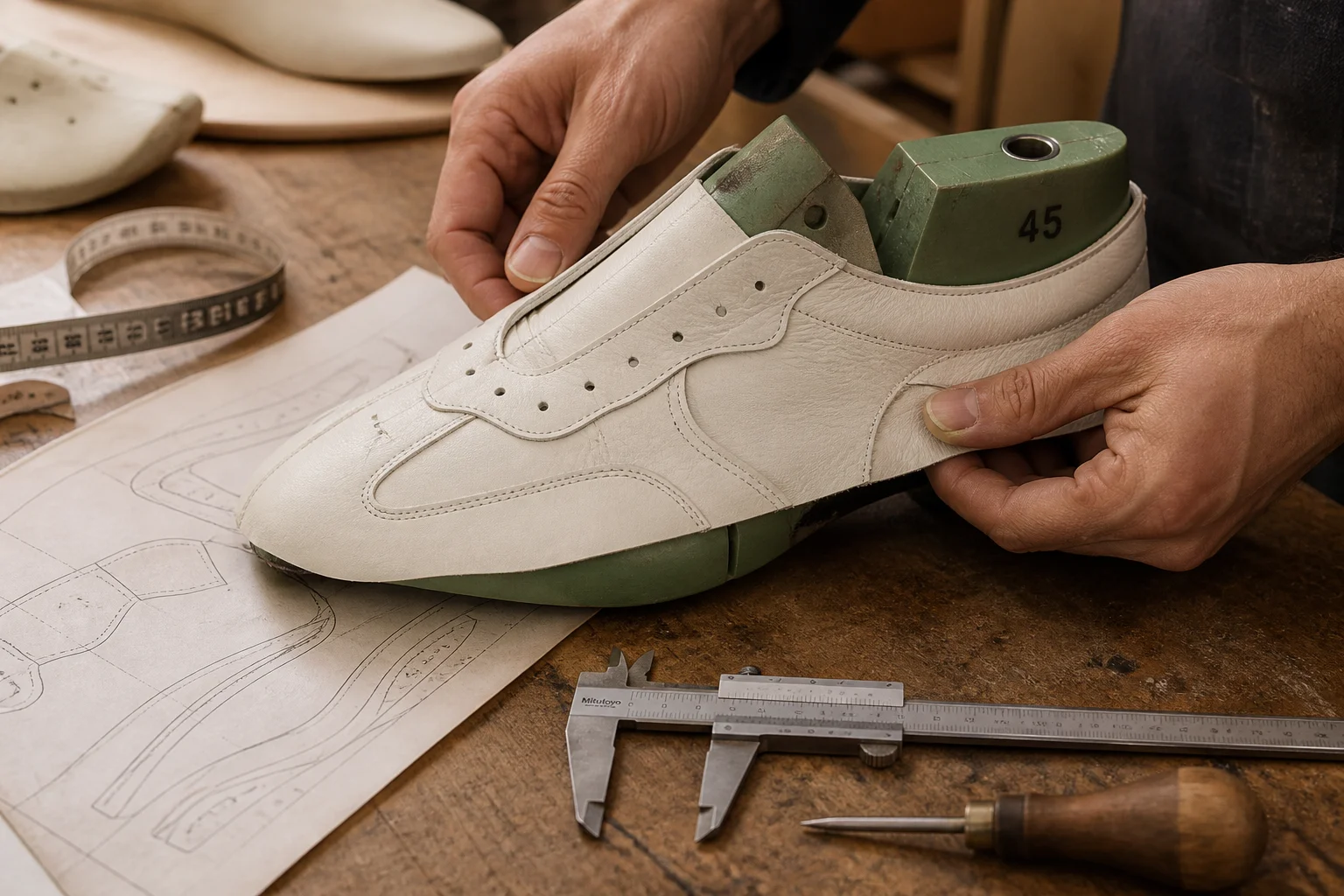
A shoe last is the three-dimensional form the upper is stretched over. It is modelled on a human foot but is not a copy of one - it translates foot measurements, gait and the designer's silhouette into a single rigid volume.
Anatomical Volumetric Control: Every fit characteristic a customer feels is fixed here. Toe shape and toe spring, heel curve, instep height, ball girth, heel width. The upper, the lining, the insole and the sole are all built to fit the last. If the last is wrong, a better leather makes the shoe look more expensive while fitting exactly as badly.
This is why two sneakers marked the same size can feel completely different, and why "we use the same factory as a big brand" is not a fit guarantee. A factory running someone else's last produces that brand's fit, developed for that brand's customer, at that brand's price architecture. It is not your fit, and it is not your customer's foot.
For brands building a repeatable range, the last is the asset. Soles and uppers can be resourced. A last you developed, own, and can re-order against is what makes size 38 fit the same in season three as it did in season one. That is also the part most buyers never ask to see in a quotation.
3. What size grading does to a woman's foot
Once a base size is approved, the last is graded - scaled up and down across the run. In the arithmetic grading convention used across UK and US sizing, each full size adds 8.47 mm of length and 6.35 mm of joint girth. Those increments are fixed. They are applied identically whether the customer's foot grew that way or not.
It does not grow that way. Work published by Frey in Foot & Ankle International (1995) measured forefoot and heel width across women's shoe sizes and found the two do not expand at the same rate. Across roughly US 5 to US 10 - five full sizes - the average forefoot widened from 8.1 cm to 9.51 cm, an increase of 14.1 mm, while the average heel widened from 5.6 cm to 6.1 cm, an increase of 5.0 mm. The forefoot grew about 2.8 times faster than the heel.
⚠️ Arithmetic Uniform Grading (The Failure Mode)
By the time you reach the top of a women's run, a shoe built on proportional grading has a forefoot that is too tight and a heel that is too loose at the same time. The customer experiences this as heel slip in a size that pinches her toes - and returns it as "wrong size", which tells you nothing.
✅ Anatomical Asymmetric Last (The Solution)
Frey's study recorded that 86% of the women measured were wearing shoes narrower than their feet in the forefoot, by an average of 0.88 cm. Decoupling heel expansion from forefoot ball girth through non-linear grading solves the root mechanical defect.
This is the mechanism behind most of the fit returns in your account, and it is structural. No amount of upper engineering fixes a cross-section that was determined by a fixed grading increment.
4. Why one width cannot cover one size
The instinctive response is "offer wide fitting". The evidence says that is still not enough, and the scale of the problem is larger than a single extra width.
Jurca, Žabkar and Džeroski analysed 1.2 million 3D foot scans across North America, Europe and Asia and published the results in Scientific Reports (2019). Two findings matter for anyone building a women's range:
- Within a single length class, foot measurements are widely dispersed. Buyers are not clustered around an average foot; they spread across a broad range of widths, instep heights and heel widths at the same foot length.
- At least three shoe widths per length class are needed to fit 90% of customers. One width, or two, leaves a substantial share of the market outside the fit window by construction.
The same study found statistically significant differences in mean foot measurements between regions. A last developed and validated for one market does not automatically travel to another - which matters if you sell into the US and the EU from the same size run.
How badly brands already miss this is measurable. In a follow-up study using 90,720 foot scans matched to 841 women's running models all labelled US 9 medium, Jurca and Džeroski found that only 60% of those models fitted as a true US 9 medium (3DBODY.TECH Proceedings, 2021). Four in ten shoes carrying the same size label were, in fit terms, a different size.
Even the standards agree the label cannot carry the message. ISO 19407:2023, the international standard for converting between sizing systems, states plainly that the tables are a guideline, citing "the different ways in which each system has been developed and interpreted over many years without being formalized and the absence of solution to the problem of shoe size conversions." A size label is a convention, not a fit specification.
The myth worth dropping: It is tempting to explain all of this with "women's feet differ from men's". The evidence is weaker than the internet suggests. When researchers normalise foot measurements to foot length, several of the headline male-female differences shrink toward insignificance, and the useful variation turns out to be within each sex rather than between them. The problem is not that your customer is a woman. The problem is that she is a specific foot inside a length class built for an average one.
5. The B2B trap: three widths, one MOQ
Here is the difficulty that stops most brands from acting on any of the above, and it is a purchasing problem before it is a technical one.
Widths multiply SKUs. Take a modest women's run of six sizes at a 300-pair-per-style minimum:
| Configuration | SKUs per colourway | Pairs per SKU at 300-pair MOQ |
|---|---|---|
| 1 width × 6 sizes | 6 | 50.0 |
| 2 widths × 6 sizes | 12 | 25.0 |
| 3 widths × 6 sizes | 18 | 16.7 |
At three widths, eighteen SKUs in a single colourway carry 16.7 pairs each. Add a second and third colourway and the same 300 pairs spread across 36 and then 54 SKUs - 8.3 and 5.6 pairs per SKU. That is not a size run any retailer can replenish from, and it is not a range a buyer can present. To hold even 40 pairs per SKU at three widths you need 720 pairs per colourway, more than double the entry order.
So the brand does the rational thing: it orders one width, sells to whoever that width happens to fit, and pays the returns. The MOQ is not the obstacle. The obstacle is that adding widths was never designed into the order, only bolted onto it.
Three ways buyers get around it, in ascending order of effort:
- Two widths, split at the population, not at the middle. A standard width plus a wide width, with the wide fitting carrying the upper quartile of forefoot girth. This captures a large share of the customers currently lost, at 12 SKUs and 25 pairs per SKU. It is the most common compromise for a first season.
- One last, three size curves. Keep a single width but fix the grading itself - a slightly fuller forefoot and a tighter heel through the upper range, achieved by adjusting the last's cross-section rather than adding a width. This addresses the Frey problem directly and costs nothing in SKU count.
- Hero widths first. Launch the width that matches your top-selling size cluster and the market your returns data points to, prove the sell-through, then extend. Widths are a range decision, not a launch-day decision.
The correct answer depends on your returns data, which most brands already hold: the reason codes are sitting in the returns portal. If your codes only say "wrong size", that is the first thing to fix, because it is the only diagnosis you will ever get for free.
6. What wide width women's sneakers should actually measure
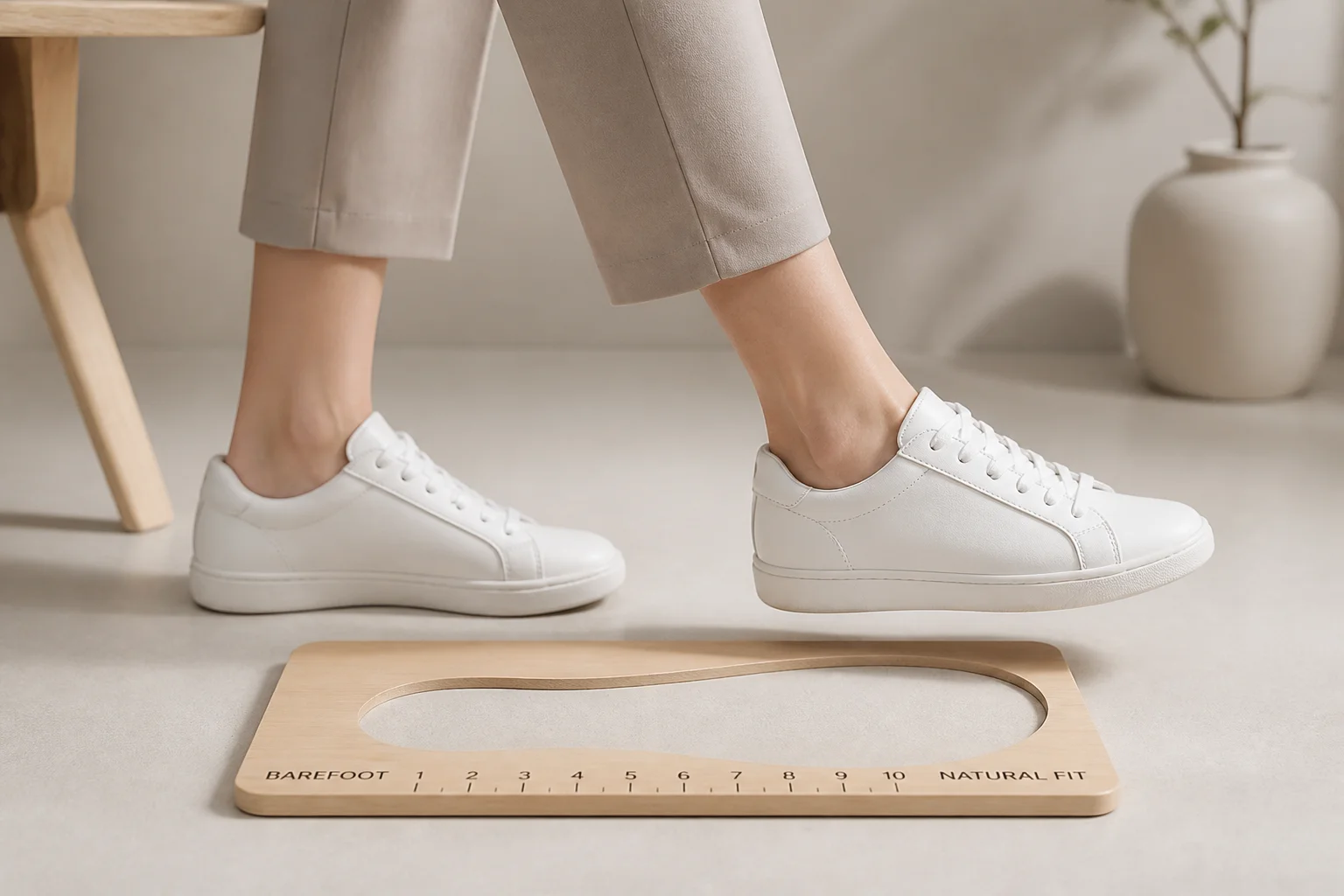
"Wide" is not one number, and this is where most wide-fitting ranges fail. A last can be wide at the ball and still be unusable if the toe box is shallow, the instep is low, or the heel is so wide the shoe slips.
Four measurements decide whether a wide width works:
- Ball girth (joint girth) - the circumference around the first and fifth metatarsal heads. This is the volume that a customer feels as "tight across the top".
- Heel width - where slip originates. Wider forefeet do not automatically come with wider heels, so a width that scales both together creates the heel-slip complaint.
- Toe box width and depth at roughly 70% of foot length - where pressure on the metatarsal heads and toes appears. A generous ball girth with a shallow toe box still pinches.
- Instep height - the measurement most often skipped in sneaker development and the most common cause of "it fits but I can't get my foot in".
Where forefoot and heel width fall into different fittings - a wide forefoot on a narrow heel - the technical answer is a combination last, a last built with two fittings in one. Frey's work flagged exactly this: women with a large forefoot-to-heel discrepancy need a combination last, and because it is not widely available, they are the customers who suffer most from poor fitting. Asking a factory whether it can build one tells you more about its technical depth than any catalogue.
7. The eight specs to write into your tech pack
Fit only holds if it is written down as a measurement rather than described as an adjective. "Comfortable, true to size, slightly wide" is not a specification; it is a hope. Eight lines turn it into one:
| Spec | What to state | Why it bites if you leave it out |
|---|---|---|
| Base last length | mm, at the model size, with toe allowance separated | Without a stated allowance, every supplier reads "size 38" differently |
| Ball girth | mm at the model size, per width | The single measurement that defines the fitting |
| Heel width | mm at the model size | Independent of ball girth; drives slip complaints |
| Toe box width / depth | mm at ~70% foot length | Prevents pinch on wide forefeet with normal ball girth |
| Instep height | mm at the reference point | The hidden cause of "can't get my foot in" |
| Length / girth grade | mm per full size, stated explicitly | Default arithmetic grading is what produces the heel-slip failure |
| Width grade | mm per width step, and how it is distributed | One number per step is not enough; distribution across the cross-section matters |
| Last tolerance | mm across production copies | Sub-millimetre drift between copies is invisible in a photo and visible in returns |
That last row is underrated. In series production, one approved last is duplicated into hundreds of copies running on several lines. Any drift between copies breaks size consistency, and inconsistent sizing shows up directly in return rates. A factory machining lasts to a stated tolerance and able to show you the measurement record is doing the thing that most of the market only claims.
8. How to prove fit before you commit to bulk
Sampling confirms that a shoe can be made. It does not confirm that it fits. Treat them as two approvals.
Step 1 - Grading Verification
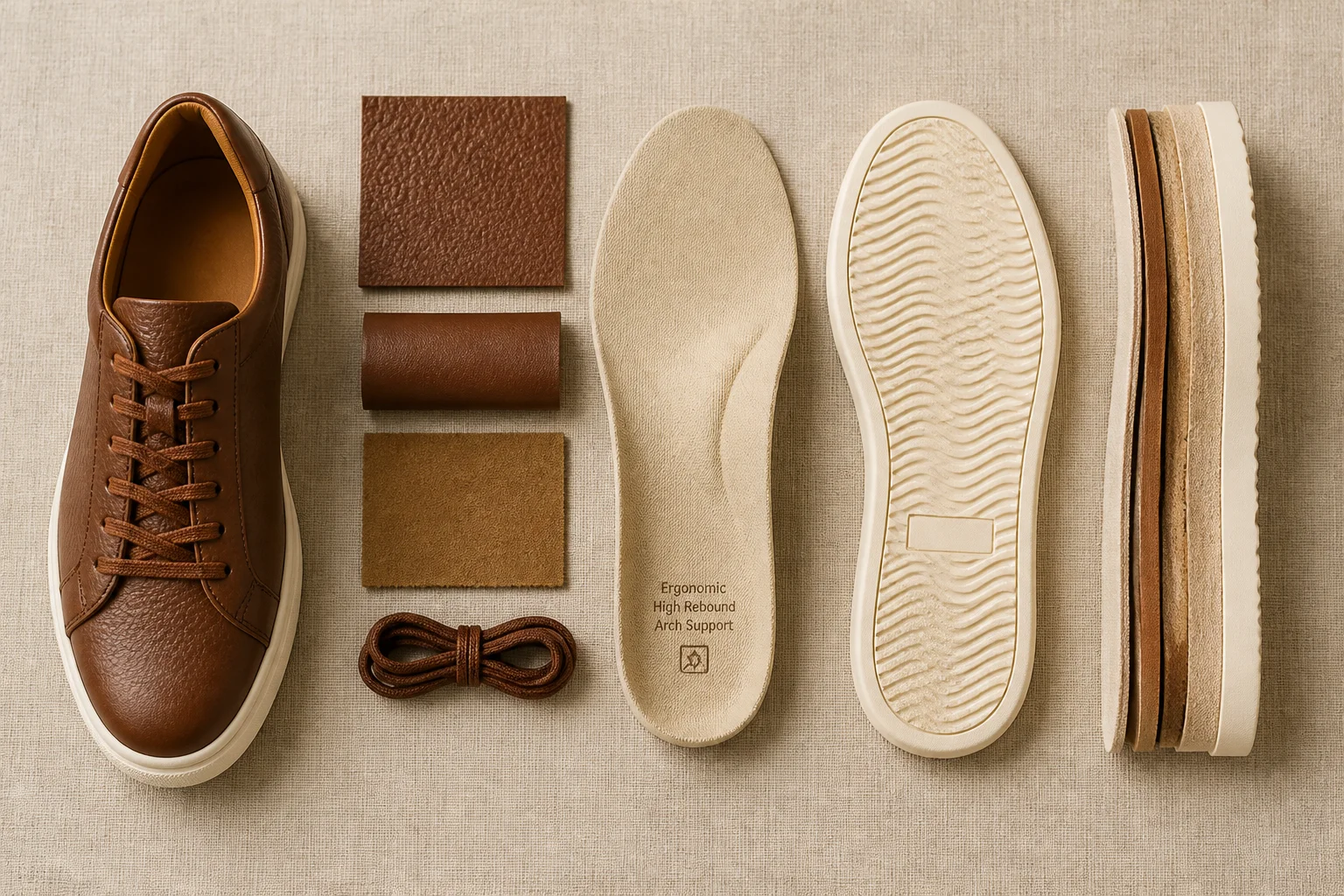
Before the wear trial, check the grade itself. A widely used manual method: align the smallest and largest graded vamps at the joint line with one edge level; the difference at the opposite edge should equal the accumulated grading. From size 5 to size 11, six sizes at 2.12 mm per side, that is 6 × 4.24 mm = 25.4 mm across the full upper. If the physical patterns do not produce that number, the grade is wrong and every size above the model size will drift.
Step 2 - Fit Trial on Real Feet
Twenty to thirty wearers per width, measured rather than asked. Foot length, ball girth and heel width, then the shoe's internal measurements, then a 30-minute walk. Record where the pressure is, not whether they "like it". A trial that only asks for a rating gives you an opinion; one that measures gives you a data set you can take to the next size.
Step 3 - Pre-Production Sample Sign-Off
Sign-off against the spec sheet, line by line, including the measurements nobody photographs. Then bulk, with first-article measurement of the lasts pulled for the run.
Brands that run all three still get some returns. Brands that skip step two get the 28% rate.
9. What one fixed style is worth
Returning to the opening example, with every assumption stated so you can substitute your own:
| Input | Value |
|---|---|
| Units ordered / sold through | 1,200 / 78% (936 units) |
| Return rate | 28% (262 units) |
| Returns attributed to fit | 70% (184 units) |
| Cost per return | $18 (reverse freight, labour, re-pack, markdown) |
| Total return cost | $4,717 |
| Retail / landed cost | $89 / $22 (gross margin $67, 75.3%) |
Cut fit-driven returns by 30% on that style and you recover about $1,651. On a first order that is not transformational. On a range of twenty styles it is a person's salary, and it repeats every season because the cause was structural, not accidental.
The comparison to weigh it against is the development cost. A last is a one-time tooling investment amortised across every reorder of that style; the returns are a recurring cost that never amortises. Buyers who treat the last as a line item in the quotation and the returns as a fact of life have the arithmetic backwards.

10. Nine questions to ask a women's sneaker manufacturer
Most factory conversations open with price and MOQ. Both are downstream of the last, so ask these first:
- Do you build lasts in-house, or source them? In-house last and mould development is what allows a cross-section to be changed at all.
- Can you modify ball girth, toe room and instep height independently? A factory that can only scale one dimension uniformly cannot solve the problem in section 3.
- Can you build a combination last - wide forefoot, narrow heel?
- What width range do you support, and at what MOQ per width rather than per style?
- What is your last tolerance, and can you show the measurement record?
- What is your grading table - mm per size for length and girth, stated explicitly?
- What is the sampling lead time for a new last, separate from the sampling time for a new upper?
- Can you supply a fit trial set in multiple widths before a bulk commitment?
- Which third-party inspections do you accept, and what certifications does the facility hold?
Solefina Manufacturing Capabilities Benchmark:
For reference, the answers at Solefina (Hangzhou Huangxuan) - the factory behind this site - are: in-house mould and last engineering with independent adjustment of ball girth, toe room and instep height; a women's sneaker range spanning EU35–EU43 / US5–US11 including wide-fit specifications; standard MOQ of 300 pairs per style/colourway with flexible size and colour distribution for first orders; 3–4 weeks for sample development after tech pack and material approval; 45–60 days bulk lead time after PPS sign-off; four-stage QC covering incoming material, in-line lasting, 100% pre-boxing and outsole flex and bonding bench testing; third-party inspection by SGS, BV or Intertek welcomed. The facility operates to BSCI and SEDEX standards and has served 30+ countries with roughly 3 million pairs a year since 2015.
Use those as a benchmark, not as a reason to stop asking. Any supplier who cannot answer questions 2, 3 and 6 is selling you a catalogue rather than a fit.
11. Frequently Asked Questions (FAQ)
Why do wide width women's sneakers still feel narrow?
Because most wide fittings are scaled from the same base last, increasing girth uniformly rather than widening the toe box and forefoot where pressure actually occurs. If heel width grows with the ball, the shoe also slips - which customers report as the wrong size rather than the wrong shape.
How many widths does a women's sneaker range actually need?
Analysis of 1.2 million 3D foot scans found that at least three widths per length class are required to fit 90% of customers. In practice most brands launch with two - standard and wide - and extend once their returns data shows which cluster they are losing.
Is a wide fit the same as sizing up?
No. Sizing up adds length as well as girth, so it moves the flex point forward, makes the heel slip and leaves the customer in a shoe that is too long for her foot. For a wide forefoot, width is the correct variable; length is not.
What is a shoe last, and why does it decide fit?
A last is the three-dimensional form the upper is built over. It sets toe shape, instep height, ball girth and heel width before any material is cut, so a better leather on a poor last produces a more expensive shoe that fits exactly as badly.
What MOQ should a small brand expect for a wide-width sneaker?
We support flexible trial orders starting from 300 pairs per style across standard size runs (with options for 200–500 pairs depending on design and material customization), allowing you to validate market demand with low inventory risk. Always ask how MOQ applies per width, not just per style.
How long does it take to develop a custom last and first sample?
Allow 7–15 days for a new last or mould where tooling is required, plus 3–4 weeks for sample production and revision after the tech pack and materials are approved. Bulk production typically follows 45–60 days after pre-production sample sign-off.
Fit is a decision you make once
The returns in the opening example were not a service failure or a quality failure. They were the predictable output of a last that was never specified, graded to a convention that does not match how women's feet scale, and offered in a single width because the MOQ made a second one feel impossible.
None of this is expensive to fix at the development stage, and none of it can be fixed after bulk - the last is a one-time tool that every reorder inherits, while the returns never stop amortising. Which is the argument I started with: fit is engineered, not marketed. Ask to see the last before you ask for the price.
CONTACT SOLEFINA TECHNICAL TEAM


